

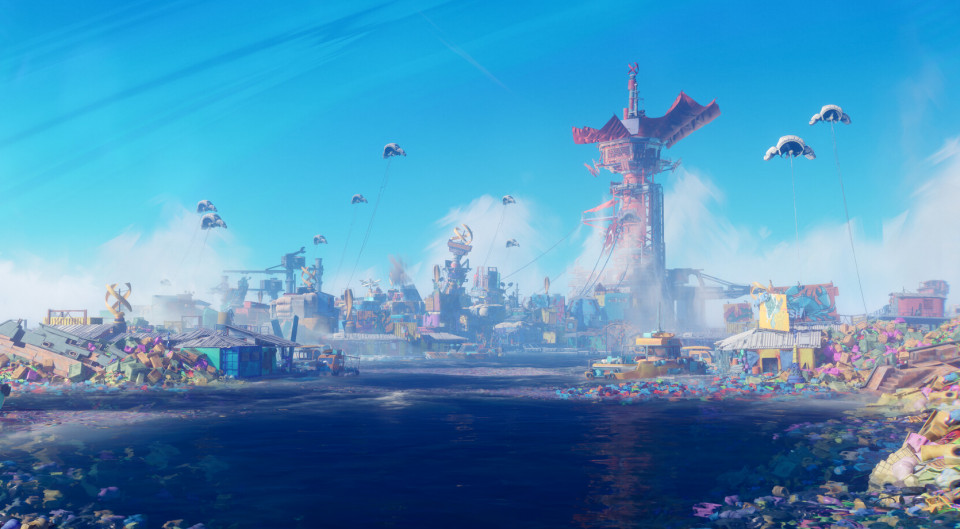
Five years after Road 96 and three years after its prequel, Mile 0, the Montpellier-based studio Digixart is back with a new project entitled Tides of Tomorrow. After completing our first (and only) playthrough in about fifteen hours, we’re going to explain why I fell in love with this new French-made production.

The world of Tides of Tomorrow is in trouble. Not only is the planet completely flooded, forcing its inhabitants to live in floating cities or on makeshift boats, but above all, it is overrun with plastic. As a result, a disease has gradually spread among the human race, and there is no cure for it, putting humanity at risk of extinction. The progression of plastemia can, however, be slowed down by consuming Ozen, a product whose exact composition is unknown. The problem is that reserves are dwindling, and a shortage seems to be looming, though it’s unclear exactly why. It must be said that certain clan leaders have reserved the right to distribute Ozen, and have found this to be an effective way to keep their people under control. Quite logically, prices are skyrocketing, and the situation is more than likely to escalate. It is into this apocalyptic atmosphere (visually very colorful—or how to make the apocalypse aesthetically beautiful) that the player arrives, as amnesiac as any stereotypical video game hero, but this obviously serves the adventure perfectly, as we will both discover this world and its stakes alongside him/her, while also understanding where he/she comes from, and why a young woman named Nahe fished him/her out of the depths of the ocean. A return to life made all the more strange by the fact that water proves to be particularly dangerous for the inhabitants of Elynd—which may, in fact, explain why the main character also suffers from plastemia. As you can see, the narrative setting diverges radically from that of Road 96, their only common point being the danger that looms over everyone. However, the goal here isn’t to run away, but to face the problems head-on and make the right decisions—even when they’re incredibly difficult (and some will be, believe me).
Just like in Road 96, one of the strengths of Tides of Tomorrow lies in its characters—who are well-written, endearing, or, on the contrary, thoroughly unlikeable. While the adventure is much longer than what we experienced in Digixart's previous game, it showcases the studio’s narrative ambitions, as it takes the time to develop its world, its stakes, and, consequently, its characters. The character you play, however, is a blank slate when the game begins, and you’ll never hear their voice. It’s up to you to shape their personality based on your behavior, choices, and desires—traits that will evolve throughout the adventure and grant you access to various narrative branches. I won’t list them all here, but they’re important, because the standout feature of Tides of Tomorrow is its asynchronous multiplayer system. In fact, as soon as you start a new game, after selecting your outfit’s color and your character’s gender, you’ll be asked to choose a player to follow, with two main traits highlighted, which will influence your own experience. The game’s heroes are called Tidewalkers, and they have the ability to perceive fragments of the past linked to the person whose trail they are following. In practice, this means that the world you’ll be exploring will already have been shaped by the player you’ve chosen to follow. As a result, some characters will be more or less pleased to meet you, depending on how your predecessor acted. Observing the past actions of the Tidewalker you will sometimes discover alternate scenarios you didn’t have access to, but it can also regularly help you overcome certain obstacles.
Since we’ve only been able to play through the entire adventure once, it’s obviously hard to guarantee that everyone will have a radically different experience, but we’ve already noticed a bunch of differences between our playthrough and that of the player who went before us. In any case, this adds to the rather mystical aspect of the plot, and it also explains why the inhabitants treat you as either a potential hero or a troublemaker. Of course, some might take issue with how the story unfolds at first, or with the very friendly attitude of certain characters right off the bat, but remember that the Tidewalkers possess a very special aura in the world of Elynd. And while characters like Eyla or Nahe are indeed very friendly and kind toward us right away, this won’t be the case for everyone we encounter later on. Over the course of the twelve to fifteen hours the adventure lasts, as the stakes are revealed and the outcome becomes increasingly uncertain, we come to fully grasp the threat hanging over the shoulders of all the inhabitants of this planet. The few plot twists give the whole story excellent pacing, and thanks to the effort to offer as varied as possible an experience, I became completely immersed in this touching story until I reached one of the various possible endings. Mine, which truly moved me deeply, left me with a bittersweet aftertaste that made me want to set off on another adventure, and if I hadn’t run out of time before the embargo was lifted, that’s exactly what I would have done. No regrets, though; I came away feeling like I’d had a very personal experience, and even if that’s probably not entirely the case, it doesn’t take away from the sheer joy I felt. The only question that remains is that if players will indeed try multiple playthroughs given the main story's length compared to Road 96, which encouraged to see everything because it was short.
When people talk about narrative games, they often assume that the gameplay mechanics will be kept to a bare minimum to make room for the story and character interactions. That was more or less the case with Road 96, but this time, the developers at Digixart have raised the bar. In Tides of Tomorrow, you don’t just chat with the residents of Elynd; there’s a whole list of varied activities and situations that help the studio avoid falling into the trap of monotony after a few hours of play. Even in the locations you traverse, you can feel their commitment to always bringing something new to the table. For the first four to five hours, for example, you’re simply exploring new areas, and even when the story takes you back to places you’ve already visited later, you either gain access to new zones, or the atmosphere—or what you’re asked to do there—is different from previous visits. I really don’t want to spoil the surprise for you, so I’ll only mention a few examples in this article, but despite a very structured gameplay framework (divided into missions that are integrated into several acts), Tides of Tomorrow does its best to avoid repetition and manages to pull it off rather well. So, of course, you’ll encounter several stealth sections, platforming sequences (admittedly scripted, but still very satisfying thanks to the excellent work on the jump animation), and even boat races, but once again, everything is skillfully organized so that I never felt bored. And since these stealth or platforming sections have no narrative consequences if you fail them (you simply restart at the last checkpoint), there’s no tension heightened by the stakes.
In fact—and this is a feeling I had even before remembering that some of the studio’s developers had worked at Ubisoft Montpellier—Tides of Tomorrow frequently reminded us of the now-cult classic Beyond Good and Evil. Traveling on water, endearing characters, the diverse gameplay mechanics, the unique universe and bold artistic direction, and even the distinctive soundtrack, blending ethnic songs with more orchestral music, sometimes accompanied by choirs, all this is reminiscent of BGE somehow. These are clearly very different styles of games of course, but I felt like I was reliving those sensations I had back in 2003, and for that alone, the game was worth it. As I mentioned earlier, the game’s structure is fairly classic. Since Tides of Tomorrow doesn’t feature an open world, boat travel is limited to areas that are fairly modest in size. Basically, you select your mission using the spyglass at the start of each chapter, and you can even choose secondary oceanic events to gather additional resources before continuing with the main story. Most of the time, this is followed by a quick load that takes you near your chosen destination, where you can roam around a bit freely (to dock at a merchant’s, for example, or collect a few crates of scrap metal—the currency of this world). The controls feel good with a controller, but the lack of vibration is sorely missed, and I hope my feedback on this point will be taken into account to make these sections more immersive. Especially since the swell is sometimes clearly noticeable because of bigger waves.
Once you’ve set foot on land, you’ll need to scour the area for scrap metal, which you can use to buy Ozen from merchants (who charge prices that are more or less reasonable), but also to repair ladders and bridges that players who choose to follow you can use later. Remember that you’ll also leave traces of your passage, whether you decide to buy the last can of Ozen, leave it for those who come after you, or even let them benefit from a discount by donating scrap metal to some of the merchants. There are also special chests that only Tidewalkers are allowed to use, in which you can find one of these two resources (or even both) left behind by your predecessors. It’s up to you to do the same for future players if you think you have enough money and Ozen to make sure your health bar won't be dropping to zero. If that were to happen to you once, don’t panic though, you won’t be greeted with a permanent “Game Over” screen, but you’ll be treated to a very special sequence. I won’t say any more so as not to spoil the surprise, but I can’t guarantee that another failure of this kind is possible because I'm not sure. Indeed, I did everything I could to avoid having to find out for myself, even if it meant becoming a little more selfish than I was at the start of the game. To avoid such a mishap, be sure to use your Ozen reserves before the mission ends so that you have enough health points to survive the plastemia crisis that occurs every time you return to open water, in the area where you select your next mission. One word of caution, though: helping others by offering Ozen to certain characters can sometimes be very important so don't be stingy all the time.



 Patreon




